

Cao Dai Temples in Vietnam: A Fascinating Meeting of Religions and Traditions
In Vietnam, spirituality finds expression through an extraordinary diversity of beliefs, rituals and traditions. Alongside Buddhist pagodas, Confucian temples and shrines dedicated to protective spirits, certain buildings immediately capture the imagination with their vibrant colours and unusual architecture: the Cao Dai temples.
Their pastel-coloured façades, columns entwined with dragons and representations of a mysterious eye seem to belong to a world where different religious traditions come together.
Originating in Vietnam in the early 20th century, Caodaism is one of the country’s most distinctive expressions of spirituality. Seeking to bring the world’s great religious traditions closer together, this faith has developed its own temples, ceremonies and sacred symbols.
Visiting a Cao Dai temple means entering a fascinating world where architecture, colours and rituals tell a story deeply connected to Vietnam’s cultural identity.
Caodaism: A Religion Born in Vietnam
Unlike Buddhism, Taoism or Christianity, whose origins lie outside Vietnam, Caodaism is a religion that originated on Vietnamese soil.
Officially founded in 1926 in Southern Vietnam, the religious movement emerged during a period of profound social, political and cultural transformation, when the country was under French colonial rule.
Its founders, including Ngô Văn Chiêu, Lê Văn Trung and Phạm Công Tắc, developed a doctrine based on the belief that the world’s major religions share a common spiritual origin.
The name Cao Đài, which symbolically refers to an elevated place where the Supreme Being resides, reflects this aspiration towards universal spirituality.
Caodaism brings together teachings from Buddhism, Taoism, Confucianism and Christianity, while maintaining its own religious practices, organization and identity.
This desire to unite different spiritual traditions is one of the most remarkable characteristics of this uniquely Vietnamese religion.
A Philosophy Based on Harmony Between Beliefs
At the heart of Caodaism lies the conviction that different spiritual traditions can lead towards the same divine truth.
Respect for living beings, compassion, the pursuit of harmony and individual moral development all play important roles in its teachings.
Followers are encouraged to cultivate kindness, practise charity and live according to ethical principles.
Vegetarianism is also part of Cao Dai religious practice, although requirements vary according to each follower’s level of spiritual commitment.
Another distinctive feature of Caodaism is the importance it gives to certain influential figures from world history and philosophy.
Alongside Buddha, Confucius and Lao Tzu, personalities such as Victor Hugo are recognized in certain Cao Dai traditions as spiritual figures who helped transmit religious teachings.
This openness to different cultures and philosophies gives Caodaism its profoundly original identity.
This openness to different cultures and philosophies gives Caodaism its profoundly original identity.
The Cao Dai Holy See in Tay Ninh: An Extraordinary Sanctuary
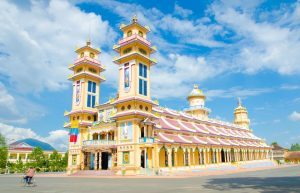 Located in Tay Ninh Province, approximately 100 kilometres northwest of Ho Chi Minh City, the great Cao Dai temple is the spiritual centre of the Tay Ninh branch of Caodaism.
its construction began in 1933 and continued over several decades before the temple’s official inauguration in 1955.
From the moment you arrive, the building surprises visitors with its monumental architecture and unusual combination of colours.
Its façade, dominated by two towers, recalls certain Western cathedrals, while its roofs, decorative details and sculptures reflect Asian architectural traditions.
This combination is far more than a decorative choice. It expresses Caodaism’s ambition to bring different religious influences together within a single place of worship.
Inside, long rows of columns decorated with colourful dragons support an immense central hall beneath a ceiling painted to resemble a luminous sky.
Every colour, motif and architectural detail carries religious symbolism.
At the far end of the sanctuary, an enormous globe bearing the Divine Eye immediately draws attention.
Together, these elements create a spectacular setting unlike the traditional Buddhist pagodas found elsewhere in Vietnam.
The Divine Eye: The Mysterious Symbol of Caodaism
Among the many symbols found in Cao Dai temples, the Divine Eye, known in Vietnamese as Thiên Nhãn, holds a central place.
Usually represented as an open left eye, it symbolizes the presence and watchful gaze of the Supreme Being over humanity.
For followers, the eye serves as a reminder that the divine is present everywhere and that human actions carry moral and spiritual significance.
It appears on altars, temple façades, religious objects and sometimes inside the homes of believers.
Its distinctive appearance makes Cao Dai places of worship immediately recognizable.
At Tay Ninh, the Divine Eye dominates the main sanctuary, surrounded by celestial imagery and symbols drawn from several religious traditions.
Attending a Cao Dai Ceremony: A Unique Cultural Experience
A visit to a Cao Dai temple becomes particularly memorable when it coincides with a religious ceremony.
At the great temple in Tay Ninh, followers traditionally gather for four daily services, held at midnight, 6:00 a.m., noon and 6:00 p.m.
The midday ceremony is generally the most accessible for visitors.
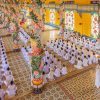
Dressed in long white robes, worshippers take their places according to a carefully established order, while certain religious dignitaries wear garments in symbolic colours.
Yellow is associated with Buddhism, blue with Taoism and red with Confucianism in the clothing worn by particular religious officials.
Chanting, prayers and synchronized movements unfold in a solemn and deeply spiritual atmosphere.
Sunlight filtering through the windows, brightly coloured columns and long rows of worshippers create a particularly striking scene.
Witnessing this ceremony offers an important insight into the fact that Cao Dai temples are not simply remarkable architectural monuments. They are, above all, living places of worship.
Visitors should naturally remain discreet and respectful throughout the service.
Where Else Can You Discover Cao Dai Temples in Vietnam?
Although the sanctuary in Tay Ninh is the best known, Caodaism also has numerous places of worship throughout Vietnam.
Cao Dai temples and communities can be found in several provinces of the Mekong Delta, around Ho Chi Minh City and in certain parts of Central Vietnam.
These sanctuaries are generally more modest than the great temple at Tay Ninh, but they preserve the principal religious symbols of Caodaism. The Divine Eye, colourful altars and architectural details combining different influences remain central features.
Visiting these smaller temples offers a more intimate understanding of local religious life.
In some towns and villages, Cao Dai temples form a natural part of the everyday landscape, surrounded by houses, markets and local activities.
For travellers interested in spirituality and cultural traditions, they can provide particularly rewarding experiences, especially when opportunities arise to meet members of the local community.
How to Visit a Cao Dai Temple in Vietnam
You do not need to follow Caodaism to visit one of its temples. Visitors are generally welcome, provided they respect the customs and rules of each religious community.
Appropriate clothing is essential. Shoulders and knees should be covered, and shoes should be removed when entering designated prayer areas.
During ceremonies, visitors should remain quiet, avoid disturbing worshippers and respect areas reserved for religious participants.
Photography may be permitted in certain parts of the temple, but it is always advisable to ask for permission before photographing ceremonies.
The Cao Dai Holy See in Tay Ninh can easily be included in an excursion from Ho Chi Minh City.
A visit can also be combined with Ba Den Mountain, another important spiritual landmark in the region.
Why Visit Cao Dai Temples During Your Trip to Vietnam?
Vietnam has an exceptionally rich religious history, shaped by Chinese, Indian and Western influences as well as its own deeply rooted popular traditions.
Caodaism perfectly illustrates the country’s ability to absorb different influences while developing a distinctive spiritual identity.
Visiting its temples introduces travellers to a lesser-known aspect of Vietnamese culture, beyond the country’s famous historical monuments and spectacular natural landscapes.
It also provides an opportunity to better understand the importance of religious beliefs and spiritual practices in the everyday lives of many Vietnamese people.
For travellers interested in history, architecture and meaningful cultural encounters, Cao Dai temples offer a discovery that is both surprising and deeply enriching.
Discover Another Side of Vietnam with Senteurs du Vietnam
Travelling through Vietnam also means taking the time to discover the beliefs, traditions and stories that have shaped the country’s identity.
Cao Dai temples reflect this remarkable cultural richness through their unusual architecture and a spiritual tradition born from the meeting of several major world religions.
At Senteurs du Vietnam, we enjoy including experiences in our journeys that go beyond conventional sightseeing and help travellers develop a deeper understanding of Vietnam and its people.
Whether attending a religious ceremony in Tay Ninh, exploring a village pagoda or meeting artisans who continue to preserve traditional skills, every experience adds another dimension to the journey.
Would you like to discover Cao Dai temples and Vietnam’s fascinating cultural heritage?
We can help you create a tailor-made journey through Vietnam, combining historical heritage, living traditions and authentic local encounters.