

During a trip to Vietnam, many visitors quickly notice an element present almost everywhere: an altar decorated with photos, incense, flowers and offerings. Whether you enter a family home, a business or even a hotel, this discreet but essential presence bears witness to a tradition deeply rooted in Vietnamese society: the cult of ancestors in Vietnam.
More than a simple religious practice, this tradition occupies a central place in the Vietnamese culture. It reflects the Vietnamese vision of the family, intergenerational respect and the invisible link between the living and the deceased. In Vietnam, ancestors symbolically continue to accompany their descendants, protect the family and participate in the balance of the home.
Pour les voyageurs, comprendre cette coutume permet de porter un regard totalement différent sur le pays. Derrière chaque autel, chaque bâton d’encens ou chaque cérémonie familiale se cache une relation profonde à la mémoire, à la transmission et à l’harmonie familiale.
In this article, we invite you to discover how ancestor worship works in Vietnam, why this practice remains essential today and what it reveals about the Vietnamese soul. You will also understand the meaning of altars, offerings and rituals that still punctuate the daily life of millions of Vietnamese families.
What is ancestor worship in Vietnam?
Ancestor worship in Vietnam is a spiritual and family tradition of honoring deceased family members through regular prayers, offerings and ceremonies. This practice, deeply rooted in Vietnamese traditions, is based on the idea that ancestors continue to exist spiritually and remain linked to the living.
In Vietnam, the deceased are not considered to be totally absent. They remain symbolically present with their descendants and play a protective role within the household. Maintaining this relationship is seen as a key responsibility of the Vietnamese family.
Ancestor worship is not exactly a religion in the Western sense. Rather, it is a set of beliefs and practices influenced by several currents of thought:
- Confucianism, which values respect for parents and elders
- Buddhism, very present in Vietnamese society
- Taoism and Vietnamese popular beliefs
This is why the religion of Vietnam often appears complex to travelers: several spiritual influences coexist and naturally mix in daily life.
In the majority of Vietnamese families, ancestors occupy a central symbolic place. The link between generations is considered fundamental to maintain family harmony and transmit family values.
This relationship is manifested in particular through:
- the prayers before the family altar
- the offerings of incense and food
- the ceremonies held on the occasion of death anniversaries
- the major traditional festivals like Tet
So, how does ancestor worship work in Vietnam?
It is primarily based on:
- respect
- family memory
- gratitude towards previous generations
For many Vietnamese, honoring ancestors helps to preserve the balance of the home and maintain a spiritual link between past, present and future.
The traveler who discovers Vietnam quickly understands that this tradition goes far beyond the religious framework. It still structures family life, social behavior and the way Vietnamese perceive their history and roots.
 Why do the Vietnamese honor their ancestors?
 Why do the Vietnamese honor their ancestors?
To understand the cult of ancestors in Vietnam, we must first understand the fundamental importance of the family in Vietnamese society. In Vietnam, the individual is rarely seen in isolation: he belongs to a lineage, a family history and a continuity between generations.
Honoring one’s ancestors is therefore a way to preserve this bond and express gratitude to those who have passed on life, values and family heritage.
Respect for the family and generations
One of the bases of Vietnamese culture is based on the notion of filial piety, inherited from Confucianism. This value teaches respect for parents, grandparents, and elders more broadly.
In the Vietnamese family, ancestors play an essential symbolic role:
- they represent family roots
- they embody the continuity of the lineage
- they transmit values and traditions
Respect for ancestors is manifested daily through:
- prayers
- the maintenance of the family altar
- commemorative ceremonies
- family gatherings
This practice also strengthens the bonds between living generations. Children learn very early the importance of family memory and respect for elders.
The spiritual link between the living and the dead
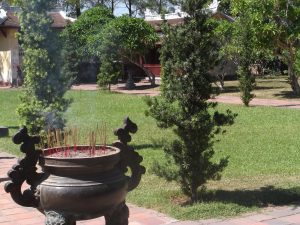 In Vietnamese beliefs, ancestors never completely disappear. They symbolically continue to accompany the family and can influence the harmony of the home.
That is why many Vietnamese consider that the ancestors:
- protect their descendants
- bring luck and prosperity
- watch over the family
This spiritual relationship explains why ceremonies and offerings remain so important today.
So, why do the Vietnamese pray to their ancestors?
Because these gestures express:
- gratitude
- respect
- the need to maintain a link with those who preceded current generations
In Vietnamese thinking, forgetting one’s ancestors would mean losing part of one’s family and cultural identity.
This vision still deeply influences modern Vietnamese society. Even in large cities and among younger generations, respect for ancestors remains a strong value, often considered essential to family balance.
The altar of ancestors: a central element in Vietnamese homes
To understand the cult of ancestors in Vietnam, it is often enough to observe the interior of a Vietnamese house. In the vast majority of homes, a specific space is dedicated to ancestors: the family altar.
This altar, called “bàn thờ” in Vietnamese, occupies a deeply symbolic place in daily life. It represents the link between generations and is a constant reminder of the importance of family memory in Vietnamese culture.
Even in the modern apartments of large cities, it is rare for a Vietnamese family not to have its own altar.
What do you find on an altar of the ancestors?
An ancestor altar in Vietnam usually has several symbolic elements.
There are often:
- photographs of the deceased
- incense sticks
- candles or lamps
- fresh flowers
- fruits and food offerings
- religious or symbolic objects
Incense holds a particularly important place. When the Vietnamese light incense sticks, they symbolically address their thoughts and prayers to the ancestors.
The altar is also maintained with great care. Keeping it clean and harmonious is considered a mark of respect towards previous generations.
For travelers, this space may seem very spiritual, but it is above all part of daily life and Vietnamese customs.
The meaning of the offerings
Ancestor offerings in Vietnam play an essential role in family rituals. They symbolize respect, gratitude and sharing with the deceased.
Depending on the occasion, families lay at the altar:
- some fruits
- tea or rice wine
- traditional dishes
- some flowers
- sometimes symbolic votive papers
These gestures have a strong emotional and spiritual value. They reflect the idea that ancestors symbolically continue to be part of the family.
The meaning of the altar of ancestors in Vietnam therefore goes far beyond decoration or religion. The altar represents:
- family continuity
- the transmission of values
- respect for the origins
During major festivals, especially during the Tet, altars become even more important and occupy the center of family gatherings.
For foreign visitors, understanding the place of this altar often helps to better interpret many behaviors of Vietnamese daily life. It reveals a society deeply attached to memory, family and respect for past generations.
The major ceremonies related to ancestor worship
The cult of ancestors in Vietnam is not limited to everyday actions. Throughout the year, several ceremonies and family celebrations strengthen the link between the living and past generations.
These moments play an essential role in Vietnamese traditions and still shape family life today, both in the countryside and in the big cities.
Tet: the most important moment of the year
Tet, the Vietnamese New Year, is the most important period for ancestor worship. This major family celebration symbolizes renewal, transmission and a return to the roots.
On this occasion:
- families carefully clean the houses and altars
- special offerings are prepared
- the relatives gather around traditional meals
- family graves are maintained and visited
In Vietnamese beliefs, the Tet is a time when ancestors symbolically return to share celebrations with the living. The family altars then become the heart of the home.
For travelers in Vietnam during this period, it is possible to observe how the family and the memory of ancestors occupy a central place in Vietnamese society.
Death anniversaries and family ceremonies
In Vietnam, the death anniversaries of family members are also very important. These ceremonies, called “giỗ”, allow to pay homage to the ancestors and to reunite the family.
On this occasion:
- prayers are organized
- traditional meals are prepared
- offerings are deposited on the altar
- several generations come together
These ceremonies are not only religious; they strengthen family ties and perpetuate Vietnamese family traditions.
Even in modern Vietnam, these practices remain deeply alive. Many Vietnamese living far from their region of origin return to their families to participate in these commemorations.
These rituals show that ancestor worship in Vietnam remains above all a human and family tradition. Through these ceremonies, the Vietnamese preserve the memory of their loved ones and transmit their values to new generations.
The cult of ancestors and religions in Vietnam
For many travelers, the religion Vietnam may seem difficult to understand at first glance. In the same house or temple, it is common to observe Buddhist, Confucian, Taoist influences and practices related to ancestor worship in Vietnam.
This spiritual coexistence is one of the peculiarities of Vietnamese culture.
Unlike some religions organized around a single dogma, Vietnamese spirituality is often based on a harmonious blend of beliefs and traditions.
Ancestor worship has thus been influenced by several currents:
- Confucianism
- Buddhism
- Taoism
- Vietnamese popular beliefs
Thus, the cult of ancestors in Vietnam goes far beyond the strict religious framework. Many Vietnamese practice these rituals without necessarily defining themselves as religious.
This tradition is above all:
- in the family
- cultural
- identitarian
It constitutes a link between:
- the past and the present
- the living and the dead
- family memory and modern society
For Western travelers, this approach may seem very different from the European view of religion. In Vietnam, spirituality and daily life are deeply linked.
Understanding this dimension allows us to have a much deeper view of Vietnamese society. Behind each altar, each ceremony or each incense stick hides a particular way of conceiving:
- the family
- the transmission
- the respect
- the harmony
What travelers must understand and respect
Discovering the cult of ancestors in Vietnam not only allows to better understand Vietnamese society, but also to adopt a respectful attitude during a trip.
How to behave before an altar of the ancestors
Facing an altar of the ancestors in Vietnam, it is recommended:
- to avoid touching the present objects
- to ask for permission before taking photos
- to stay discreet and calm
The altar represents the symbolic presence of the ancestors and therefore deserves a respectful attitude.
Why this tradition helps to understand Vietnam
This tradition reveals:
- the importance of respecting elders
- the central role of the family
- the transmission of values between generations
- the link between past and present
Understanding this dimension profoundly transforms the experience of traveling in Vietnam.
A tradition still alive in modern Vietnam
Despite the country’s rapid urbanization and modernization, ancestor worship in Vietnam remains deeply embedded in Vietnamese society.
Even among the younger generations:
- the family altars remain present
- the ceremonies continue to be celebrated
- traditions are passed on to children
Modern Vietnam thus illustrates a remarkable coexistence between modernity and traditions.
This faithfulness to ancestors reflects a deeply Vietnamese vision of progress:
- moving forward without forgetting one’s origins
- to evolve without breaking the link with past generations
It is precisely this alliance between modernity and tradition that makes Vietnam so fascinating and deeply human.
Conclusion
Ancestor worship in Vietnam is one of the essential foundations of Vietnamese culture.
Through family altars, ceremonies and offerings, the Vietnamese maintain a permanent link with their history, their origins and the generations that preceded them.
Understanding this tradition allows us to discover a more intimate, more human and deeply authentic Vietnam. Behind each ritual are essential values:
- respect
- gratitude
- memory
- family harmony
For us, it is often in these dimensions invisible at first glance that reveals all the cultural richness of Vietnam.
Do you want to discover a more authentic and deeply cultural Vietnam?
We create immersive journeys to better understand the traditions, beliefs and daily life of Vietnam through human encounters and unique local experiences.
Contact us to build a tailor-made trip to the heart of Vietnamese culture