

Perfume Pagoda near Hanoi: The Fascinating History of a Legendary Sanctuary
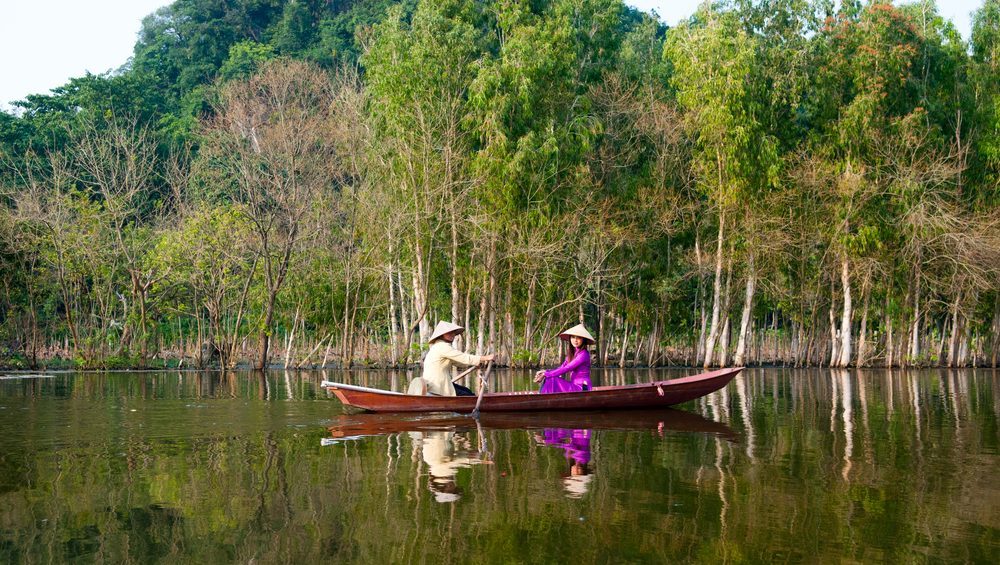
As you leave Hanoi behind, the constant energy of the Vietnamese capital gradually gives way to a quieter landscape. Then comes one of the most memorable moments of the journey: approaching the Perfume Pagoda, known in Vietnamese as Chùa Hương, by boat. Seated in a small rowing boat, you glide gently along the Yến River, surrounded by the limestone mountains of Hương Sơn.
Long before the first sanctuary comes into view, the rhythm of the journey seems to change. Behind this beautiful scenery lies a history spanning several centuries. The Perfume Pagoda is neither a single pagoda nor simply a popular day trip from Hanoi.
It is an extensive religious complex deeply connected to Vietnamese Buddhism, pilgrimage traditions and the spiritual heritage of the country. Understanding its history allows you to experience its temples, stairways and, above all, the mysterious Hương Tích Cave from an entirely different perspective. Join us as we explore one of Northern Vietnam’s most remarkable spiritual sites, where history, faith and spectacular landscapes come together.
The Perfume Pagoda: Much More Than a Single Temple
he English name can be slightly misleading. The Perfume Pagoda is not one isolated religious building. It is an extensive complex of pagodas, temples, shrines and caves scattered throughout the mountainous landscape of Hương Sơn, in Mỹ Đức District, southwest of central Hanoi.
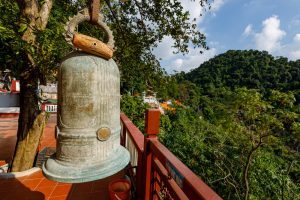
In Vietnamese, the complex is known as Chùa Hương. Its geography is one of the reasons the site feels so exceptional. Religious architecture here is not separated from nature. Instead, temples and sanctuaries gradually become part of the surrounding landscape. Water, limestone mountains, lush vegetation and natural caves combine to create what feels like an immense spiritual landscape.
This also explains why visiting the Perfume Pagoda requires more time than a conventional temple visit.
You don’t simply arrive, admire the architecture and leave. You follow a journey. You cross different religious spaces, gradually moving through the mountains towards the site’s most sacred destination: Hương Tích Cave.
For Vietnamese pilgrims, this journey has profound spiritual significance. For international travellers, it offers a fascinating opportunity to discover a more intimate side of Vietnamese Buddhism and traditional beliefs.
A Sanctuary between Mountains, Water and Spirituality
 A traditional visit begins on the Yến River. The boat journey is one of the most iconic images associated with Chùa Hương and gives the approach to the sanctuary an almost timeless atmosphere.
During quieter periods, small rowing boats glide peacefully between green limestone mountains. The surrounding landscape is reflected in the water, and for a moment, the noise and energy of Hanoi seem incredibly distant.
During the main pilgrimage season, however, the experience changes completely. The number of boats increases dramatically and the peaceful journey becomes part of a vast collective movement towards the sanctuaries.
This connection between nature and spirituality is fundamental to understanding the Perfume Pagoda.
Within many Asian spiritual traditions, mountains, caves and other natural features can themselves acquire sacred meaning. At Hương Sơn, religious architecture therefore maintains a constant dialogue with the natural landscape.
The Perfume Pagoda is best understood as a spiritual journey. The river marks the entrance into the sacred landscape. Pagodas and temples punctuate the route. The mountain introduces the physical effort of the ascent. And at the end of the journey lies Hương Tích Cave, the spiritual heart of the complex.
What Is the History of the Perfume Pagoda?
The history of the Perfume Pagoda should be approached with some care because religious traditions, stories passed down through generations and documented historical events have gradually become intertwined.
The site’s spiritual origins are ancient. Historical sources associate some of the earliest religious constructions at Hương Sơn with the 15th century, during the Lê dynasty. However, the complex we see today was not created all at once.
It developed gradually over several centuries through successive periods of construction, restoration and the growing importance of pilgrimage. Monks and worshippers established different sanctuaries throughout a landscape considered particularly suitable for contemplation and religious devotion. This gradual development explains the diversity of Chùa Hương today. The complex is the result of a centuries-old relationship between a remarkable natural environment and the spiritual practices that gradually took root within it.
One of the most important developments came as Hương Tích Cave acquired a special reputation. Over time, the cave became a major place of devotion, attracting pilgrims seeking protection, prosperity, family happiness or simply wishing to express their faith.
From Ancient Sanctuary to Major Religious Complex
Chùa Hương continued to develop over the following centuries. Pagodas were constructed or enlarged, while the religious route connecting the different sanctuaries gradually became more established.
Among the most important sites is Thiên Trù Pagoda, whose name is often translated as “Heavenly Kitchen”. Today, it remains one of the major stops along the pilgrimage route before the ascent towards Hương Tích.
During the 17th and 18th centuries, the complex gained increasing recognition. Its connections with political and religious elites also contributed to its growing prestige.
One particularly famous episode occurred in 1770, when Lord Trịnh Sâm visited Hương Tích and left an inscription praising it as one of the most beautiful caves of the South. Beyond the poetic nature of the inscription, this recognition demonstrates the considerable prestige the sanctuary had already acquired by the 18th century.
From this period onwards, Hương Sơn’s reputation extended far beyond its immediate surroundings. The beauty of the landscape, the presence of its sanctuaries and the sacred character attributed to Hương Tích Cave combined to make the Perfume Pagoda one of Northern Vietnam’s most important spiritual destinations.
Destruction, Reconstruction and a Living Heritage
The history of the Perfume Pagoda has not been a continuous story of preservation. Like many historic monuments in Vietnam, the religious buildings of Hương Sơn have experienced periods of conflict, destruction and reconstruction.
Some structures were severely damaged during the conflicts that affected Vietnam during the 20th century. Restoration and reconstruction work subsequently allowed the religious complex to continue fulfilling its spiritual role.
This is important to understand when visiting the Perfume Pagoda today. Not every building you see has remained untouched for hundreds of years. Vietnamese heritage is often a living heritage—restored, maintained, rebuilt and continuously embraced by the communities that continue to use these sacred places.
This is precisely what makes Chùa Hương so compelling. Its importance does not depend solely on the age of its stones or buildings. It lies above all in the continuity of a tradition. Generations of pilgrims walked through these mountains, followed these paths and descended into Hương Tích Cave long before the Perfume Pagoda became a popular destination for international travellers.
Hương Tích Cave: The Sacred Heart of the Perfume Pagoda
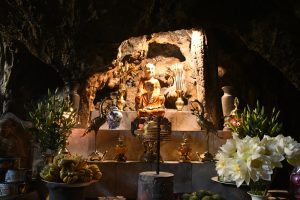 After the peaceful boat journey and the discovery of the first sanctuaries, the route leads towards the most symbolic place within the Perfume Pagoda complex: Hương Tích Cave. As you approach, the atmosphere changes. Here, the mountain itself becomes the sanctuary.
The monumental entrance opens into a darker, mineral world. Religious statues and altars stand alongside natural rock formations to which tradition has attributed different symbolic meanings. For pilgrims, Hương Tích is therefore much more than a geological curiosity. It is a sacred place of prayer and contemplation, where worshippers come to make offerings and express their hopes and wishes.
The cave’s reputation is also closely associated with Lord Trịnh Sâm, who visited the site during the 18th century. The inscription attributed to him in 1770 celebrated Hương Tích as a cave of exceptional beauty, further strengthening its place in the cultural history of Northern Vietnam.
Today, entering Hương Tích Cave remains one of the most memorable moments of a visit. After the open landscapes of Hương Sơn, the contrast is striking. The light fades. The surrounding rock encloses the space.
The sounds of the pathway gradually give way to a more introspective atmosphere. Even visitors who do not share the religious beliefs of the pilgrims can appreciate the powerful symbolism of the place.
The Legend behind the Perfume Pagoda
To fully understand Chùa Hương, we need to look beyond dates, dynasties and architectural history. Like many of Asia’s great religious sanctuaries, its identity has also been shaped by spiritual stories passed down through generations.
The site is particularly associated with the worship of Quan Âm, the Buddhist figure of compassion who is deeply revered throughout Vietnam. Religious traditions connected with Hương Sơn recount her spiritual journey and help explain the sacred character attributed to the mountain and its caves.
However, these traditions should be distinguished from documented history. They belong to the world of religious belief and should not be interpreted as historical chronology in the same way as dated buildings, inscriptions or recorded events.
Yet they remain essential to understanding how pilgrims experience Chùa Hương. At the Perfume Pagoda, a natural rock formation can carry symbolic meaning. A cave can become a place of devotion. A mountain ascent can become a spiritual journey. It is precisely this meeting of history, legend and living faith that gives Chùa Hương a depth that goes far beyond the architectural value of its monuments.
The Perfume Pagoda Festival: A Living Pilgrimage
.
Every year after the Lunar New Year, Chùa Hương undergoes a remarkable transformation. The Perfume Pagoda Festival attracts large numbers of pilgrims from across Vietnam.
From the early hours of the morning, boats begin travelling along the Yến River. Paths become crowded, sanctuaries fill with worshippers and the peaceful atmosphere experienced during quieter periods gives way to an intense expression of collective devotion.
For many Vietnamese visitors, the pilgrimage is closely associated with hopes and wishes for the new year—good health, family happiness, professional success and prosperity. The festival demonstrates that Chùa Hương is not simply a historic monument. It remains a deeply important place of living religious practice.
For international travellers, visiting during this period can provide an intense cultural experience. You discover the Perfume Pagoda not as a heritage site preserved primarily for visitors, but as a genuine place of worship.
There is, however, an important consideration: visitor numbers can be considerably higher during the pilgrimage season. If you are looking for tranquillity, contemplation and a peaceful boat ride through the landscapes of Hương Sơn, visiting outside the busiest festival days will generally provide a more serene experience. If, on the other hand, you want to experience the energy and religious devotion of a major Vietnamese pilgrimage, the festival offers an unforgettable perspective on the site
How to Visit the Perfume Pagoda from Hanoi
The Perfume Pagoda is generally visited as a day trip from Hanoi. We recommend dedicating a full day to the experience rather than treating it as a short excursion of only a few hours.
The journey first takes you gradually away from the urban environment of the Vietnamese capital. Once you reach the Hương Sơn region, the adventure traditionally continues by rowing boat along the Yến River. This boat journey is not simply a transfer from one place to another. It is an essential part of the experience.
After arriving, you continue through the religious complex, discovering different sanctuaries before making your way towards Hương Tích Cave. Depending on your physical condition and how your visit is organized, some parts of the journey can also be made easier by the infrastructure available on site.
How Much Time Should You Allow?
We recommend setting aside a full day from Hanoi. Trying to rush the excursion would take away much of its character.
Chùa Hương is a place best experienced gradually. Allow time for the boat journey, the temples, the ascent and the moments when you simply stop and observe the surrounding landscape.
The excursion also provides a fascinating contrast with Hanoi. After the scooters, narrow façades and constant energy of the capital’s streets, Hương Sơn reveals a completely different Vietnam—one shaped by limestone mountains, vegetation, water and spirituality.
When Is the Best Time to Visit the Perfume Pagoda?
There is no single best time to visit the Perfume Pagoda. The right period depends largely on the experience you are looking for.
During the festival season, traditionally held after Tết and during the first months of the lunar calendar, the site reveals the full extent of its religious significance. The atmosphere is vibrant and fascinating, although visitor numbers can be extremely high. As the exact festival dates depend on the lunar calendar, they should always be checked for the year in which you plan to travel.
Outside the pilgrimage season, Chùa Hương offers a much quieter experience. The Yến River becomes more peaceful and it is easier to take your time exploring the landscapes, temples and sanctuaries.
For us, these two experiences are not opposites.
One reveals the vitality of religious tradition in contemporary Vietnam.
The other allows you to appreciate the beauty and spirituality of the site in a more intimate atmosphere.
For us, these two experiences are not opposites. One reveals the vitality of religious tradition in contemporary Vietnam. The other allows you to appreciate the beauty and spirituality of the site in a more intimate atmosphere.
Why Include the Perfume Pagoda in Your Vietnam Itinerary?
The Perfume Pagoda near Hanoi has the rare ability to combine several different experiences within a single day. You may initially visit for its Buddhist heritage, but your memories are just as likely to be of a small rowing boat moving quietly along the Yến River, the limestone silhouettes of Hương Sơn rising from the landscape and the descent into the mysterious darkness of Hương Tích Cave.
Its centuries-old history, continually enriched by generations of pilgrims, also reminds us that Vietnamese heritage is not confined to monuments from the past. At Chùa Hương, beliefs remain alive. Sanctuaries continue to welcome worshippers. Traditions still bring people together.
At Senteurs du Vietnam, we enjoy including places such as the Perfume Pagoda in tailor-made itineraries whenever they reflect the interests and sensibilities of our travellers. Beyond Vietnam’s most famous landmarks, Chùa Hương offers an opportunity to discover a more profound and spiritual side of the country, where landscapes, history and living traditions tell the story of Vietnam together.
Would You Like to Discover the Perfume Pagoda and the Treasures of Northern Vietnam? We can create a personalized journey from Hanoi combining iconic destinations, meaningful encounters and more intimate experiences away from the most conventional routes.