


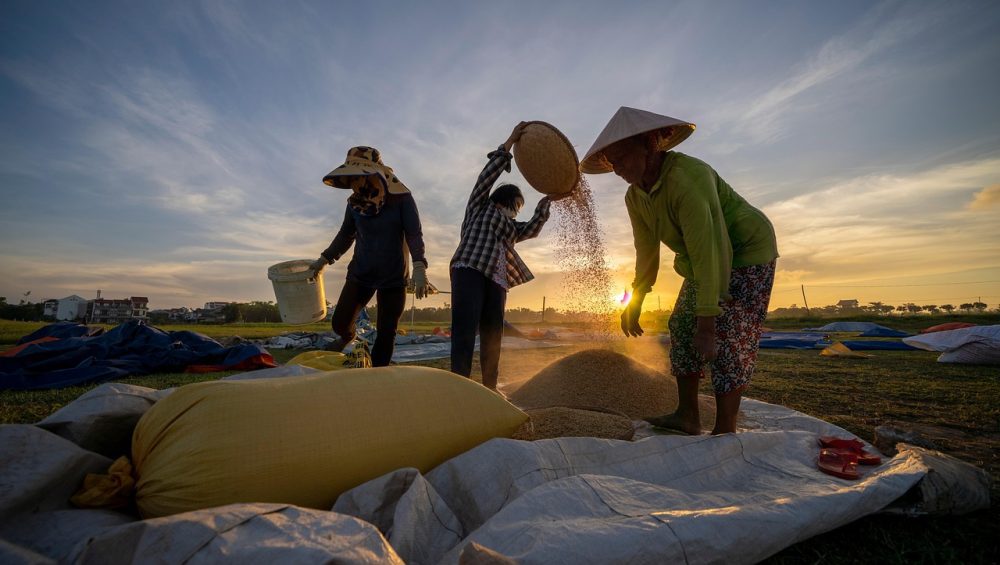
When the first morning lights caress the mountains of North Vietnam, the rice terraces are adorned with an almost unreal golden glow. The valleys then fill with a vibrant energy: families gather in the fields, buffaloes move slowly between terraces and the air carries the delicate scent of ripe rice.
The rice harvest in Vietnam is more than just a farming season. It represents a deeply living moment, a period when the landscapes become spectacular and where Vietnamese traditions are expressed with a rare authenticity.
For travelers, it is often the most magical time to discover the country.
In the mountainous regions of North Vietnam such as Sapa, Mu Cang Chai or Hoang Su Phi, rice harvesting usually takes place between September and October. The rice fields then take absolutely magnificent golden hues that transform the mountains into grandiose natural paintings.
In the Mekong Delta, in southern Vietnam, climatic conditions allow several harvests per year, offering almost permanent agricultural landscapes.
At Senteurs du Vietnam, we consider this period as one of the most fascinating to explore rural Vietnam. Between majestic panoramas, human encounters and cultural immersion, the rice season offers a deeply unforgettable experience.
When does the rice harvest take place in Vietnam?
Vietnam has an extremely varied geography. Between the northern mountains, the central plains and the tropical southern delta, agricultural seasons change considerably depending on the region.
In North Vietnam, the main harvest usually takes place:
- from late August to early October in Sapa,
- during the month of September in Mu Cang Chai,
- between September and October in Hoang Su Phi,
- sometimes until November in some higher valleys.
It is during this period that the famous rice terraces reach their visual peak. The fields become luminous, almost flamboyant under the autumn sun.
In Central Vietnam, agricultural calendars vary more depending on rainfall and provinces. Some regions experience two crop cycles due to more favorable climatic conditions.
In the Mekong Delta, the constant heat and abundance of water often allow two to three annual harvests. Rice here structures the entire landscape and way of life.
This climatic diversity explains why Vietnam remains one of the world’s largest rice producers today.
Pourquoi les dates de récolte changent-elles selon les régions ?
The cultivation of rice directly depends on several natural elements:
- altitude,
- temperatures,
- monsoon rains,
- irrigation systems,
- sunshine duration.
In the mountains of North Vietnam, cooler temperatures often limit crops to a single large annual harvest. Farmers must then exploit the steep mountain slopes to create the impressive terraced rice fields that have made the region famous.
Each plot has been shaped by hand for generations. Some terraces literally seem to be suspended in the clouds.
In the south of the country, the fertile plains of the Mekong River enjoy a warm tropical climate throughout the year. This allows farmers to multiply crop cycles and produce rice almost continuously.
For travelers, this agricultural wealth offers a considerable advantage: it is possible to observe different stages of cultivation depending on the period of travel.
The best time to see the rice fields in Vietnam
The Vietnamese rice fields change their atmosphere completely with the seasons. Some periods offer green and refreshing landscapes while others reveal particularly photogenic golden panoramas.
The choice depends mainly on the experience sought.
The green rice fields: a fresh and bright atmosphere
Between June and August, young rice shoots gradually cover the valleys of North Vietnam.
 The landscapes then become intensely green. The terraces draw harmonious curves that perfectly fit the mountains.
This period is particularly attractive for:
- lovers of landscape photography,
- travelers who are passionate about hiking,
- lovers of lush nature,
- travelers seeking wilder panoramas.
After the summer rains, the valleys are often covered with spectacular morning mists. The mountains appear and then slowly disappear into the clouds, creating an almost mystical atmosphere.
The ethnic villages then seem isolated in the heart of a deeply soothing setting.
Even if showers remain possible at this time, the light often becomes exceptional after the rain. The contrasts between dramatic sky, emerald green terraces and dark mountains create scenes of striking beauty.
 The golden rice fields: the most spectacular season
 The golden rice fields: the most spectacular season
Between September and October, the rice fields reach maturity.
The valleys of North Vietnam then turn into a huge golden ocean. Under the warm light of autumn, the mountains take on particularly photogenic bright hues.
For many travelers, this is the most magical time of the year.
Harvesting animates the Vietnamese countryside from sunrise to sunset:
- the families cut the rice by hand,
- the buffaloes slowly cross the fields,
- the children play near the terraces,
- the sheaves of rice are drying in front of traditional houses.
This season reveals all the poetry of rural Vietnam.
Photographers from around the world come to capture the spectacular landscapes of Mu Cang Chai or the valleys of Sapa bathed in an almost unreal golden light.
It is also the ideal time to experience authentic encounters with local communities.
Where to see the best rice harvests in Vietnam?
Some Vietnamese regions offer absolutely exceptional rice landscapes. Each destination has its own atmosphere, relief and cultural identity.
Sapa and the Muong Hoa Valley
Nestled in the mountains of the northwest, Sapa remains one of Vietnam’s most iconic destinations.
The region attracts by:
- its majestic terraced rice fields,
- its deep valleys,
- its Hmong and Dao villages,
- its spectacular hiking trails.
During the harvest season, golden terraces cover mountains as far as the eye can see. Each turn reveals impressive panoramas where the shades of yellow, orange and green blend harmoniously.
Muong Hoa valley offers some of the most famous landscapes in the region. Hiking allows you to cross ethnic villages and observe the daily life of the inhabitants at the rhythm of the harvests.
At dawn, when the mists still float above the terraces, the atmosphere becomes truly magical.
Mu Cang Chai: the most photogenic rice fields in Vietnam
Mu Cang Chai is often considered the absolute jewel of Vietnamese rice fields.
Here, the mountains seem sculpted by infinite golden waves. The terraces perfectly follow the reliefs and create spectacular curves that attract photographers from all over the world.
During the harvest season, the region becomes dazzling.
The landscapes offer:
- breathtaking panoramas,
- incredible panoramic roads,
- an atmosphere still preserved,
- deeply authentic rural scenes.
Unlike some more touristic destinations, Mu Cang Chai retains a sense of adventure and immersion.
The villages seem to hang between the mountains while the inhabitants continue their ancestral agricultural traditions.
The Khau Pha Pass, particularly famous, offers some of the most spectacular viewpoints in North Vietnam.
Hoang Su Phi: the confidential experience
Less known than Sapa or Mu Cang Chai, Hoang Su Phi is nevertheless one of the most beautiful rice-growing regions in Vietnam.
Classified as national heritage, its terraced rice fields cover steep mountains where several ethnic minorities live.
The region appeals to travelers in search:
- of authenticity
- of human encounters,
- of wild landscapes,
- of experiences off the beaten track.
Here, tourism remains discreet. The villages retain a deeply traditional atmosphere.
During the harvest, the valleys take on an almost cinematic dimension. The golden terraces seem to go down to the bottom of the valleys in perfect harmony.
Homestays offer a particularly enriching cultural immersion experience.
Pu Luong: the peaceful elegance of Vietnamese rice fields
Located just a few hours from Hanoi, Pu Luong appeals to travelers seeking a gentler and more serene experience.
the region combines:
- harmonious rice fields,
- traditional villages,
- unspoilt nature,
- relaxing atmosphere.
Unlike the very mountainous regions of the extreme north, Pu Luong offers a more accessible relief while maintaining splendid landscapes.
The famous bamboo water wheels, small paths lined with rice paddies and houses on stilts create a particularly soothing atmosphere.
Thanks to its specific climate, some valleys can experience several crop cycles per year, allowing you to admire the rice fields for long periods.
How do the inhabitants live during the rice harvest?
The harvest season is one of the most important moments of the year in the Vietnamese countryside.
Beyond the beauty of the landscapes, this period reveals all the human and cultural richness of rural Vietnam.
An essential season for Vietnamese families
Rice plays a central role in Vietnamese culture.
For centuries, it has structured:
- food,
- the local economy,
- the traditions,
- the rhythms of life.
In the villages, harvesting often mobilizes the whole family. The inhabitants work together from morning until sunset to cut the rice, transport it and then dry it.
This mutual aid is part of the values deeply rooted in the Vietnamese countryside.
Although some regions are gradually modernizing, many mountain valleys continue to use traditional farming methods.
Observing these scenes allows us to better understand the attachment of local populations to their land and their traditions.
The authentic scenes that mark travelers
Traveling during the rice harvest offers deeply human moments.
At the bend of a path, it is common to see:
- women carrying heavy baskets of rice,
- children playing near the terraces,
- buffalo still plowing certain plots,
- families sharing a meal after the harvest.
These simple scenes often create the most vivid memories of a trip to Vietnam.
The generosity of the inhabitants, the smiles exchanged and the beauty of the landscapes give this experience a particularly emotional dimension.
In the ethnic regions of North Vietnam, travelers also discover fascinating cultures where traditions are still very present.
Tips for organizing a trip during the rice season
Discovering the Vietnamese rice fields at the perfect time requires appropriate preparation in order to fully enjoy the landscapes and climatic conditions.
What weather should we expect during the harvest?
Quel temps devons-nous attendre pendant la récolte ?
Temperatures become milder and the sky often clearer after heavy summer rains.
The conditions are particularly favorable for:
- hiking,
- the photo circuits,
- treks in the mountains,
- cultural discoveries.
A few showers remain possible at altitude, but they often bring a spectacular light after their passage.
How many days are expected in the rice fields of North Vietnam?
To fully enjoy the landscapes and avoid a too fast trip, we recommend:
- 2 to 3 days in Sapa,
- 3 to 4 days in Mu Cang Chai,
- several nights at the locals’ house in Hoang Su Phi,
- a full week for an in-depth tour.
Taking your time allows you to live a much more immersive experience.
The most beautiful memories are often born from simple moments: a walk at sunrise, a meal shared with a local family or an improvised meeting on the edge of the rice fields.
Why rice harvesting is an unforgettable experience in Vietnam
The rice harvest in Vietnam is about more than just landscape.
She represents the deep soul of the country.
In the northern mountains, golden valleys reveal an authentic Vietnam, deeply attached to its traditions and rural communities.
Each region has its own identity, majestic landscapes and rhythm of life. Between the spectacular rice fields of Mu Cang Chai, the misty valleys of Sapa or the unspoilt landscapes of Hoang Su Phi, travelers discover a fascinating, serene and intensely lively world.
This season also offers a rare human immersion.
Encounters with locals, traditional farming scenes and the beauty of landscapes create deeply impactful memories.
At Senteurs du Vietnam, we design tailor-made trips to allow you to discover the most beautiful rice regions of Vietnam at the perfect time.
Our tours focus on authenticity, local encounters and immersive experiences to make you live an elegant, human and truly unforgettable Vietnam.