

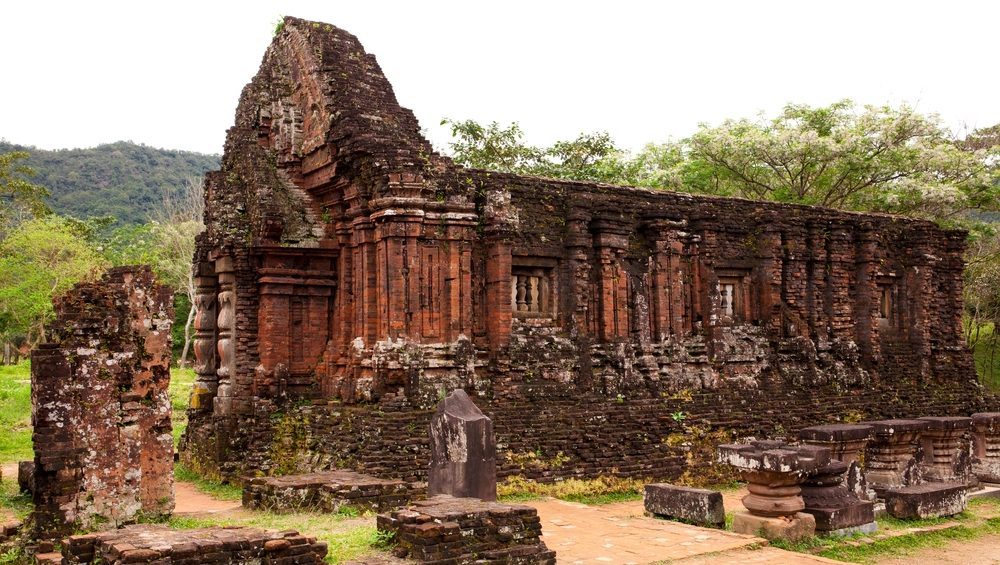
In the heart of central Vietnam, hidden in a valley surrounded by green mountains and tropical jungle, lies one of the country’s most fascinating historical sites: the My Son Shrine.
Upon arrival at the site, the atmosphere immediately changes.
The noise of the world seems to gradually disappear to give way to the silence of the forest, the song of birds and the mysterious presence of ancient red brick temples.
Unlike large, dynamic and lively Vietnamese cities, My Son offers a much more spiritual atmosphere, almost timeless.
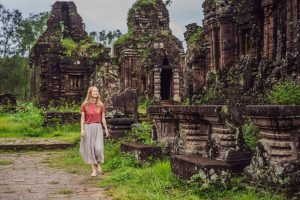
The remains slowly appear between the trees, sometimes partially covered by tropical vegetation, creating a particularly captivating feeling of exploration and discovery.
We quickly understand why this place fascinates so much the travelers impassioned of history, culture and heritage.
But My Son is not just a simple archaeological site.
Above all, it is the legacy of an ancient and long unknown civilization:
the Cham kingdom, also called the Champa kingdom.
 For more than a thousand years, this maritime power dominated much of central Vietnam and developed a culture deeply influenced by India, Hinduism and Asian trade.
At its peak, the Champa kingdom was one of the great maritime civilizations of Southeast Asia.
Even today, the remains of the Cham kingdom continue to fascinate:
- for their unique architecture
- their artistic refinement
- their spirituality
- and the mystery that surrounds this ancient civilization
The sculptures, sacred towers and religious symbols bear witness to a world that has disappeared, but whose influence remains deeply visible in certain regions of Vietnam.
Who were the Chams really?
Why is My Son considered one of Vietnam’s greatest cultural treasures?
And why does this site deserve an important place in a route in the center of the country?
In this complete guide, we take you to discover the Cham kingdom and the sanctuary of My Son, between history, spirituality, UNESCO heritage and cultural immersion.
Who were the Chams? Understanding the Champa kingdom
The Champa kingdom is one of the most fascinating and least-known civilizations in Southeast Asian history.
For more than a millennium, the Chams have developed a refined culture, deeply spiritual and oriented towards international maritime exchanges.
Their legacy is still visible today through several historical sites in central Vietnam, but also in some cultural traditions that are still alive.
To fully understand the magic of My Son, it is essential to discover the history of the Cham kingdom and the influence it has exerted for centuries on the region.
Birth of the Champa kingdom
The Champa kingdom appears around the second century in the center of present-day Vietnam.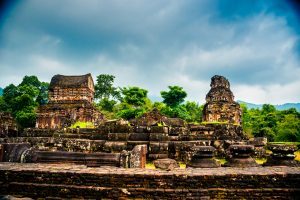
At that time, the territory was composed of several Cham principalities installed along the maritime coasts.
Thanks to their strategic geographical position between China, India and Southeast Asia, the Cham quickly became powerful maritime traders.
The kingdom then controlled part of the most important trade routes in the region.
Cham ships cross the seas of Asia to trade with:
- India
- China
- Java
- Cambodia
- and even some regions of the Middle East
This opening towards the outside plays a major role in the development of the kingdom.
Champa thrives thanks to:
- the spice trade
- precious wood
- ivory
- handmade products
- and to international cultural exchanges
Unlike imperial Vietnam, which was heavily influenced by Chinese civilization, the Cham kingdom is gradually developing a very different cultural identity, more oriented towards the Indian world.
This cultural distinction today explains why the Cham temples have unique architecture and spirituality in Vietnam.
A civilization deeply influenced by India
One of the most fascinating features of the Cham kingdom is its extremely strong Indian influence.
Through trade and cultural exchanges with India, the Cham gradually adopted:
- Hinduism
- Sanskrit
- certain Indian artistic forms
- and Hindu religious traditions
This influence profoundly transforms the identity of the Champa kingdom.
The Cham temples built between the 4th and 13th centuries still bear witness today to this cultural connection with ancient India.
The shrine of My Son then became the main religious center of the kingdom.
The temples were mainly dedicated to the god Shiva, considered in Hinduism as the god of destruction and transformation.
Religious ceremonies held a central place in Cham society.
The kings of Champa built shrines to honor the deities and strengthen their spiritual and political power.
The priests organized:
- sacred rituals
- offerings
- religious ceremony
- complex spiritual celebrations
This Hindu influence today makes the Cham heritage absolutely unique in Vietnam, a country more marked by Buddhism and Confucianism.
Cham culture and its traditions
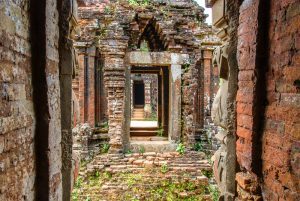 The Champa kingdom was not limited to its religious temples.
Les Chams avaient une culture particulièrement riche et sophistiquée.
The Cham company attached great importance to:
- art
- music
- dance
- sculpture
- spirituality
- and marine traffic
Cham sculptures are now considered among the finest in Southeast Asia.
The artists realized:
- statues of Hindu deities
- mythological representations
- complex religious bas-reliefs
- extremely detailed floral motifs
Each sculpture had a strong spiritual and symbolic dimension.
Dance and music also played an important role in Cham religious ceremonies.
Some Cham artistic traditions still exist today in several communities of central Vietnam.
The Cham also had a very strong relationship with nature and spiritual elements.
Mountains, rivers and forests were often considered sacred spaces related to deities.
This connection between spirituality and nature remains particularly visible at My Son, built in the heart of a valley surrounded by sacred mountains.
A major maritime power in Southeast Asia
For several centuries, the Champa kingdom was one of the major maritime powers in the region.
Thanks to their knowledge of navigation, the Chams develop an extremely dynamic commercial network.
Cham ports welcome merchants from:
- India
- China
- Indonesia
- the Middle-East
- and other Asian kingdoms
This international openness greatly enriches the culture of the kingdom.
Champa then becomes:
- an important trading center
- a major cultural crossroads
- an influential maritime power
Economic prosperity enables development:
- of the royal cities
- religious shrines
- arts
- of monumental architecture
The shrine of My Son symbolizes precisely this period of greatness and radiance of the Cham kingdom.
At its peak, the Champa controlled several territories in what is now central Vietnam and maintained complex diplomatic relations with neighboring kingdoms
The decline of the Cham kingdom
From the 15th century, the Champa kingdom gradually declined.
Several factors explain this disappearance:
- repeated military conflicts
- internal differences
- affaiblissement commercial
- expansion du Dai Viet vietnamien vers le sud
Căng thẳng giữa người Chăm và người Việt ngày càng trở nên quan trọng qua nhiều thế kỷ.
In 1471, the fall of the capital Cham marked a major turning point in the kingdom’s history.
Gradually, the Champa territory was absorbed by Vietnam.
Despite this political disappearance, the Cham culture never completely disappears.
Even today, some Cham communities perpetuate:
- their traditions
- their crafts
- their religious ceremonies
- their cultural identity
The legacy of the Champa kingdom thus continues to live through the current Cham populations and the many historical vestiges of central Vietnam.
Why the Cham kingdom still fascinates today
The Cham kingdom continues to fascinate travelers, historians and heritage enthusiasts.
Why?
Because it represents:
- a forgotten civilization
- a unique heritage
- a different Vietnam
- a rare Hindu influence in the country
- a deeply captivating story
Unlike the great, well-known Asian civilizations, the Champa kingdom still retains some mystery.
This mysterious dimension greatly reinforces the emotion felt during the visit of My Son.
Discovering the history of the Cham also helps to better understand the cultural and historical richness of Vietnam.
The country is not limited to a single cultural identity.
It was built through multiple influences, civilizations, and exchanges.
And that’s precisely what makes the sanctuary of My Son so fascinating:
it’s not just an archaeological site…
it is the living testimony of an ancient civilization that has profoundly marked the history of Southeast Asia.